
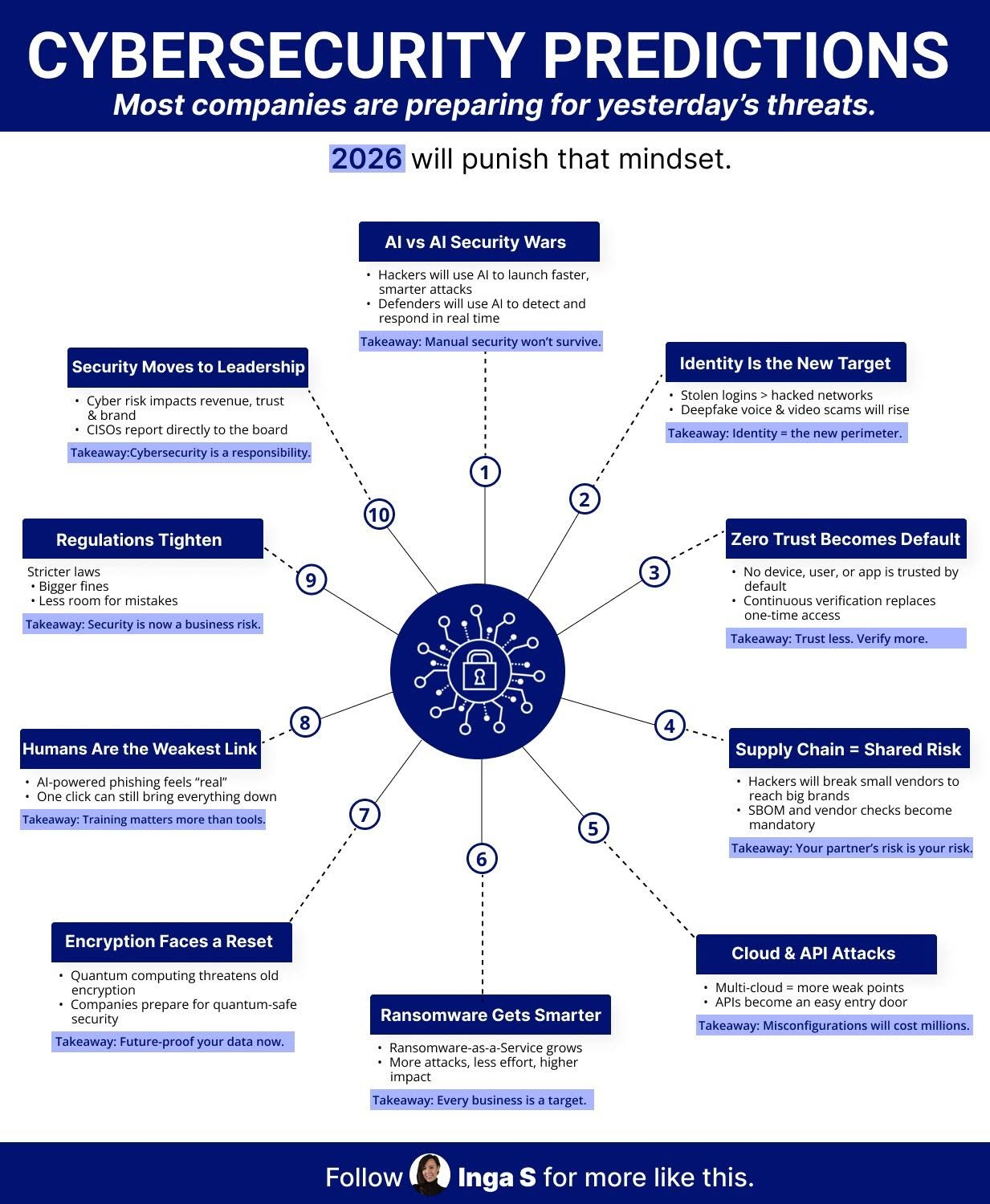
The cybersecurity industry has spent decades preparing for faster attacks, more sophisticated malware, larger botnets, and increasingly organized cybercriminal operations. Yet even as organizations invested billions into security technologies, compliance frameworks, threat intelligence platforms, and defensive infrastructure, many security leaders assumed one constant would remain unchanged: human limitations.
Attackers had to work at human speed.
Researchers discovered vulnerabilities one at a time. Criminal groups built campaigns over weeks or months. Security teams had enough time to analyze threats, deploy patches, update signatures, conduct investigations, and implement mitigations before the next major wave arrived.
That assumption is rapidly disappearing.
The cybersecurity stories dominating June 2026 are not merely individual incidents involving malware, credential theft, ransomware, botnets, software vulnerabilities, or nation-state actors. Together, they reveal the emergence of a fundamentally different threat environment where artificial intelligence, automation, identity compromise, and machine-speed decision making are reshaping every aspect of digital security.
The industry is witnessing the dawn of what many researchers now describe as the Apex Adversary: an attacker capable of operating faster than traditional security models were designed to handle.
The implications extend far beyond a single company, platform, government agency, or technology stack. They represent a structural transformation in the nature of cyber risk itself.
For years, cybersecurity followed a familiar pattern. A vulnerability would be discovered, cataloged, assessed, patched, and eventually incorporated into security programs. Threat intelligence teams would analyze campaigns, publish findings, and distribute indicators of compromise. Defenders generally maintained enough time to react.
Artificial intelligence is compressing that timeline dramatically.
Machine learning systems can now identify vulnerabilities faster, generate exploit code more rapidly, automate reconnaissance at scale, create phishing campaigns in minutes, and assist threat actors in developing attack chains that once required teams of specialists. What once took days can now happen in hours. What once took hours can now happen in minutes.
The result is an environment where organizations are increasingly challenged to maintain visibility, context, and response capabilities while attackers continue accelerating.
That acceleration is becoming particularly visible in the ransomware ecosystem. Security researchers continue documenting how AI is transforming the economics of cyber extortion. Phishing campaigns that once required extensive preparation can now be generated automatically. Social engineering messages can be customized for specific victims. Fake communications can mirror writing styles, branding, business processes, and internal workflows with alarming accuracy.
The impact is especially significant for managed service providers, IT teams, and organizations supporting distributed workforces. AI-assisted ransomware operations no longer require large criminal organizations with extensive resources. Smaller groups can now leverage automation to achieve levels of sophistication previously associated only with advanced threat actors.
This democratization of offensive capability represents one of the most important developments in modern cybersecurity.
At the same time, attackers are discovering new ways to exploit trust within artificial intelligence ecosystems themselves.
One recent security experiment demonstrated how a fraudulent AI agent skill successfully navigated marketplace approval processes and reached thousands of deployed agents, including systems associated with enterprise environments. The experiment highlights an emerging challenge many organizations have not fully addressed.
The AI ecosystem increasingly resembles the early days of mobile applications, browser extensions, cloud integrations, and software marketplaces. New tools, plugins, skills, agents, connectors, and automation packages are appearing at extraordinary speed. Every new integration expands functionality, but it also creates opportunities for abuse.
Organizations have spent years developing security strategies for software applications and cloud services. Many have yet to develop comparable frameworks governing autonomous agents and AI-powered workflows.
This creates a dangerous gap between innovation and security.
The challenge becomes even more complicated when organizations attempt to deploy AI within environments still dependent on aging infrastructure. Security leaders are increasingly discovering that legacy systems represent one of the biggest obstacles to safe AI adoption.
Many enterprises continue operating decades-old technologies that were never designed for automation, machine-to-machine communication, identity federation, or AI-driven decision making. Attackers understand these weaknesses and increasingly target the interfaces connecting modern systems to older infrastructure.
The result is a growing category of hybrid attacks that exploit both legacy weaknesses and modern automation simultaneously.
Identity security sits at the center of this transformation.
Despite years of warnings from security professionals, many enterprises continue treating identity management as a compliance requirement rather than a strategic security priority. Yet modern attacks increasingly revolve around credentials, authentication tokens, service accounts, API keys, machine identities, and privileged access pathways.
The uncomfortable truth confronting many organizations is that malware itself is often no longer the primary objective.
Access is.
Attackers increasingly seek legitimate credentials rather than malicious code execution. They prefer valid authentication sessions over noisy intrusions. They leverage existing permissions rather than deploying disruptive malware whenever possible.
This shift explains why identity security has become one of the most critical cybersecurity disciplines of the decade. Modern attackers understand that controlling identities often provides greater value than compromising devices.
Once credentials are stolen, traditional security controls become significantly less effective. A valid user session can blend into normal activity, evade detection systems, bypass perimeter defenses, and provide persistent access without triggering obvious alarms.
The growing emphasis on identity-centric attacks also helps explain why credential harvesting campaigns continue expanding globally.
One of the most significant examples emerged through a massive credential theft operation targeting FortiGate environments. Researchers identified an extensive campaign involving hundreds of thousands of firewall systems and a staggering volume of harvested credentials.
Operations of this scale demonstrate how professionalized the cybercrime economy has become. Credential theft is no longer merely a supporting activity for other attacks. It has evolved into a standalone industry.
Stolen access can be sold, rented, brokered, exchanged, or leveraged for future operations. Entire criminal marketplaces now revolve around buying and selling authenticated access to organizations worldwide.
Meanwhile, enterprise infrastructure remains under constant pressure from newly disclosed vulnerabilities affecting critical business systems.
Cisco administrators found themselves confronting active exploitation following the publication of proof-of-concept details for a serious flaw affecting Unified Communications environments. The speed with which threat actors moved from disclosure to exploitation reflects another defining characteristic of modern cybersecurity: operational timelines continue shrinking.
Public disclosure increasingly acts as a starting signal for attackers rather than a warning for defenders.
The same pattern continues across content management systems, collaboration platforms, cloud services, and security products themselves. Every disclosure creates a race between remediation and exploitation, and that race becomes harder to win as attack automation improves.
Even internet infrastructure beyond the enterprise remains under assault.
Researchers recently uncovered a large-scale operation known as AryStinger that transforms abandoned and outdated home routers into distributed reconnaissance infrastructure. Unlike traditional botnets focused primarily on distributed denial-of-service attacks, these compromised devices function as intelligence-gathering assets capable of supporting broader cyber operations.
This development illustrates how attackers increasingly value visibility and access over simple disruption.
Every connected device represents potential infrastructure.
Every forgotten router represents a potential relay.
Every vulnerable endpoint represents a potential observation point.
The expansion of these networks highlights a growing challenge facing organizations and consumers alike. The internet contains millions of aging devices that continue operating long after manufacturers stop supporting them. These systems frequently remain connected, largely unmanaged, and often forgotten.
For threat actors, they represent a nearly limitless resource.
The growing scale of cybercrime is also becoming a geopolitical concern. International law enforcement agencies continue warning about rising phishing operations, ransomware campaigns, online fraud, and AI-assisted scams throughout Asia-Pacific and other rapidly digitizing regions.
As connectivity expands and digital transformation accelerates worldwide, cybercriminal organizations gain access to larger target populations and increasingly sophisticated tools.
The result is a threat landscape where organized criminal groups often operate with capabilities once associated primarily with nation-state actors.
Governments themselves are responding in unprecedented ways.
Canadian authorities recently disclosed details surrounding an innovative legal approach that allowed government agencies to directly neutralize botnet infections affecting systems within national borders. The action represents another example of how governments are increasingly treating cyber threats as matters of national infrastructure security rather than conventional criminal investigations.
At the same time, the United States government has begun preparing for another challenge looming on the horizon: quantum computing.
The newly established federal timeline for migrating high-value systems toward post-quantum cryptography signals a historic shift in long-term cybersecurity planning. While practical quantum attacks against modern encryption remain a future concern, governments increasingly recognize that transitioning cryptographic infrastructure requires years of preparation.
Waiting until quantum threats become immediate would be too late.
Organizations face similar realities. Security strategies must increasingly account not only for today’s threats but also for technological shifts that may fundamentally alter risk models years from now.
Perhaps one of the most significant developments this year involves the growing recognition that traditional vulnerability scoring systems may no longer provide sufficient context for modern security programs.
The industry spent years relying on numerical severity ratings as a primary mechanism for prioritizing risk. Increasingly, security leaders are discovering that severity alone does not determine business impact.
A medium-severity vulnerability affecting a critical business workflow may represent greater risk than a theoretically severe flaw buried deep within an isolated environment. Attackers do not target vulnerabilities because of their score. They target them because of their usefulness.
This realization is pushing organizations toward more contextual approaches to risk management focused on exploitability, exposure, identity relationships, business impact, and attack pathways.
The cybersecurity industry is entering a period where context matters more than classification.
Ultimately, the defining lesson emerging from this week’s developments is clear. The future threat landscape will not be shaped solely by larger malware campaigns, more sophisticated ransomware groups, or increasingly capable artificial intelligence systems.
It will be shaped by speed.
Attackers are accelerating.
Automation is accelerating.
Artificial intelligence is accelerating.
Software development is accelerating.
Digital transformation is accelerating.
The organizations that thrive in this environment will not necessarily be the ones with the most security tools or the largest budgets. They will be the organizations capable of understanding relationships, maintaining visibility, managing identities, adapting quickly, and responding intelligently as threats continue evolving.
Cybersecurity is entering a new era where human-speed defenses must confront machine-speed adversaries.
The age of the Apex Adversary has begun, and every organization connected to the internet is now part of the story.