
The cybersecurity industry spent more than two decades building defenses around networks, endpoints, firewalls, intrusion detection systems, and perimeter security technologies. Organizations invested billions securing servers, laptops, cloud workloads, applications, and internet-facing infrastructure. Yet as the threat landscape continues evolving at unprecedented speed, one reality is becoming impossible to ignore: identity has become the most valuable asset in modern cybersecurity.
The biggest stories emerging across the security landscape this week all point toward the same conclusion. Whether organizations are dealing with identity fragmentation, AI-assisted attacks, Windows credential theft vulnerabilities, large-scale denial-of-service threats targeting critical web infrastructure, Android exploitation, or malware campaigns spreading through gaming communities, the common denominator remains access. Attackers no longer need to break down the front door when they can simply steal the keys.
The modern enterprise is experiencing an identity crisis unlike anything seen before. Organizations now operate across thousands of applications, multiple cloud providers, hybrid work environments, SaaS platforms, third-party integrations, contractor networks, mobile devices, and decentralized development ecosystems. Every employee possesses dozens or even hundreds of digital identities spread across systems that rarely communicate effectively with one another. Every application creates another potential entry point. Every credential introduces another layer of risk.
This fragmentation has transformed identity and access management from a compliance function into one of the most important operational disciplines in cybersecurity. Enterprises are increasingly discovering that they cannot defend what they cannot see. Visibility has become the foundation of security, and nowhere is visibility more critical than within identity infrastructure.
As organizations scale, identity data becomes scattered across departments, cloud services, business units, development teams, and external vendors. Security leaders often struggle to answer seemingly basic questions. Who has access to critical systems? Which permissions are no longer needed? Which service accounts remain active? How many dormant credentials still exist? Which users possess excessive privileges? Which applications maintain unnecessary trust relationships?
The inability to answer those questions creates enormous opportunities for attackers.
Identity Visibility and Intelligence Platforms are emerging as a response to this challenge because traditional IAM solutions were never designed for today’s interconnected enterprise environments. Organizations need systems capable of correlating identity data across thousands of applications, uncovering hidden trust relationships, exposing privilege creep, identifying orphaned accounts, and continuously monitoring authentication behaviors. The future of enterprise defense increasingly depends on understanding how identities move across environments and how attackers abuse those pathways.
At the same time, the security community is beginning to accept another difficult truth: patching alone cannot solve modern cybersecurity challenges. For years, organizations operated under the assumption that rapid patch deployment represented the ultimate defensive strategy. While patch management remains critically important, attackers continue demonstrating that defenders cannot realistically win a race against every vulnerability, every exploit, and every zero-day disclosure.
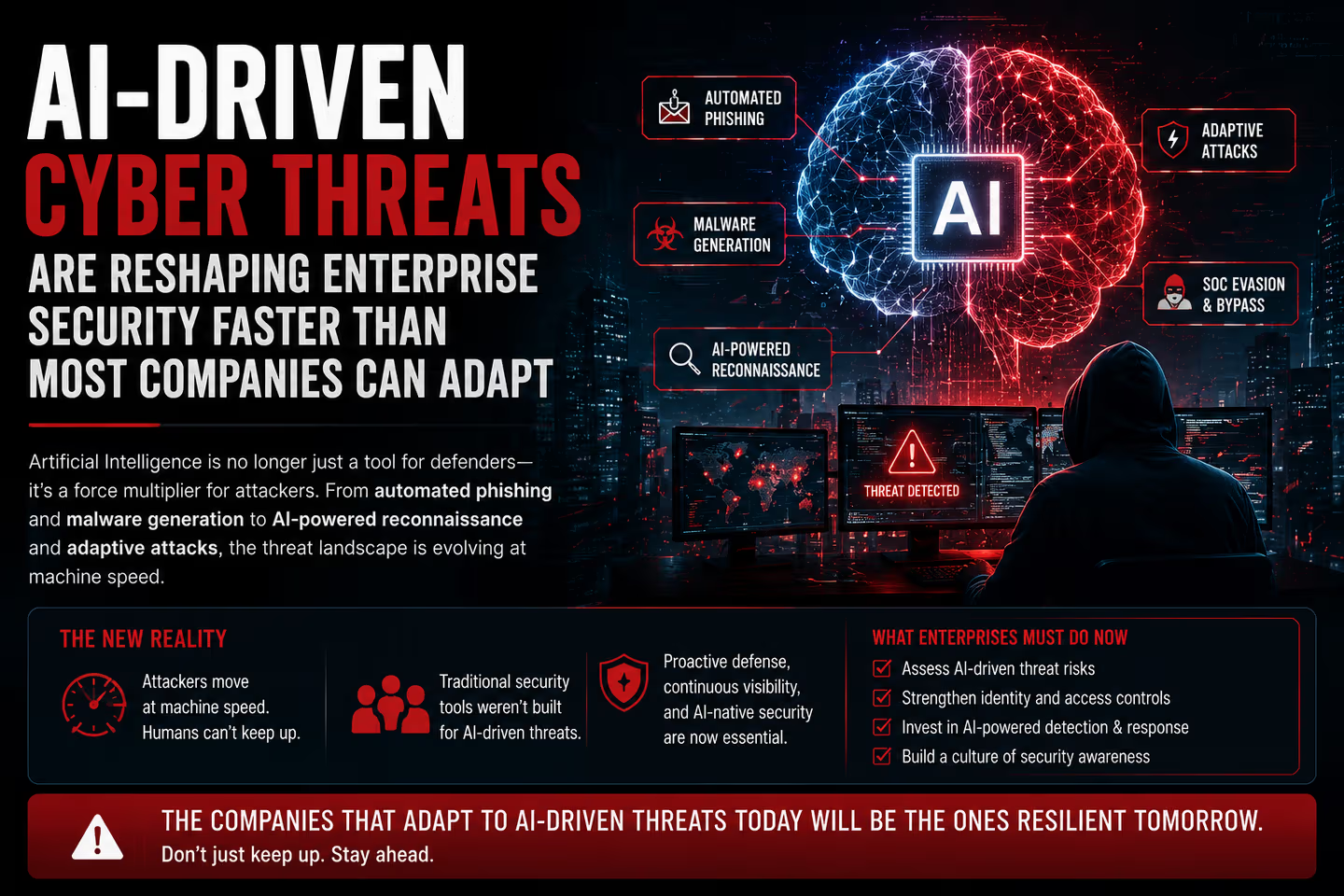
The emergence of increasingly sophisticated offensive tooling, combined with artificial intelligence capable of accelerating vulnerability research and exploit development, has dramatically changed the mathematics of cybersecurity. New vulnerabilities appear continuously. Attackers automate discovery. Exploit frameworks evolve rapidly. Organizations face mounting pressure to secure expanding attack surfaces with finite resources.
This reality is driving renewed emphasis on attack surface visibility and adversary-focused security models. Instead of asking whether vulnerabilities exist, organizations are increasingly asking which vulnerabilities actually matter. The focus is shifting from theoretical risk toward practical exposure.
The concept of viewing infrastructure through the eyes of an attacker is becoming central to modern security strategy. Threat actors rarely care about vulnerability counts or compliance reports. They care about pathways. They search for misconfigurations, exposed services, weak identities, excessive privileges, forgotten systems, and trust relationships that can be exploited to achieve objectives.
That attacker-centric perspective becomes especially important when examining newly disclosed vulnerabilities affecting widely deployed operating systems and enterprise infrastructure.
Security researchers recently revealed details of an unpatched Windows Search URI issue capable of exposing NTLMv2 authentication hashes under certain conditions. While credential exposure vulnerabilities may not always generate the same headlines as remote code execution flaws, they often prove equally dangerous in practice. Modern attackers understand that identity compromise frequently delivers more strategic value than malware deployment.
Credential theft remains one of the most effective tactics available to threat actors because legitimate credentials often bypass traditional security controls. Stolen authentication data allows attackers to blend into normal activity, move laterally across environments, access sensitive systems, and maintain persistence while generating minimal suspicion.
The continued targeting of Windows authentication mechanisms demonstrates that identity-focused attacks remain among the most effective strategies available to adversaries. Every credential represents potential access. Every authentication process represents an opportunity for abuse.
Meanwhile, a newly disclosed HTTP/2 denial-of-service vulnerability affecting major web infrastructure platforms highlights another growing challenge facing modern organizations. The issue impacts some of the most widely deployed technologies on the internet, including NGINX, Apache HTTP Server, Microsoft IIS, Envoy, and other critical components responsible for processing vast amounts of global web traffic.
What makes infrastructure vulnerabilities particularly concerning is their ability to affect entire ecosystems simultaneously. Modern internet services rely heavily on shared technology stacks. A single protocol-level weakness can potentially impact cloud providers, hosting companies, SaaS platforms, government systems, media organizations, financial institutions, healthcare providers, and e-commerce environments all at once.
The discovery of vulnerabilities affecting core internet infrastructure reinforces a reality many organizations overlook: cybersecurity is not solely about protecting individual applications. It is also about protecting the foundational technologies that power the internet itself.
The challenge becomes even more complex as organizations increasingly rely on distributed architectures, microservices, cloud-native deployments, edge computing environments, and API-driven ecosystems. Every additional layer introduces new dependencies, new trust relationships, and new opportunities for exploitation.
This week’s developments also highlight the continuing evolution of endpoint security. For years, endpoint protection served as the centerpiece of many cybersecurity programs. Traditional antivirus solutions evolved into Endpoint Detection and Response platforms capable of monitoring behavior, collecting telemetry, and detecting advanced threats. Today, however, even EDR is rapidly becoming baseline functionality rather than a competitive differentiator.
The overwhelming majority of organizations now deploy some form of endpoint detection technology. That widespread adoption is forcing both defenders and attackers to adapt. Threat actors increasingly assume EDR is present and design campaigns specifically intended to evade, bypass, or overwhelm detection systems.
This evolution is driving the next phase of cybersecurity innovation, where resilience, visibility, threat hunting, attack path analysis, identity intelligence, and automated response capabilities become just as important as prevention itself. Security leaders are beginning to recognize that no technology can guarantee perfect protection. The focus is shifting toward rapid detection, containment, recovery, and operational continuity.
The growing sophistication of malware campaigns targeting consumer audiences reinforces this reality. Researchers recently identified a large-scale operation targeting Minecraft players through social media and video-sharing platforms. These campaigns leverage the popularity of gaming communities to distribute malware capable of compromising systems, stealing information, and providing attackers with remote access.
Gaming-related attacks continue thriving because they exploit trust, enthusiasm, and curiosity. Young users often download modifications, utilities, custom content, and third-party tools without fully understanding the associated risks. Threat actors understand this dynamic and increasingly weaponize gaming ecosystems as distribution channels.
At the same time, malware operators continue expanding beyond traditional targets. Campaigns involving CountLoader infections, cryptocurrency miners, and pirated software distribution networks demonstrate how cybercriminals exploit virtually any opportunity to gain access to victim systems.
These operations are increasingly automated, scalable, and financially motivated. Attackers no longer need to target high-profile enterprises exclusively. Large volumes of consumer devices can collectively generate substantial profits through credential theft, cryptomining, advertising fraud, botnet activity, and access brokerage operations.
Mobile security remains another critical battleground. Google’s latest Android security update addressing more than one hundred vulnerabilities, including at least one actively exploited flaw, illustrates the ongoing challenge of securing the world’s most widely deployed mobile ecosystem.
Mobile devices now function as authentication platforms, financial tools, communication hubs, productivity systems, identity repositories, and remote workstations simultaneously. The amount of sensitive data stored on smartphones continues growing, making them increasingly attractive targets for both criminal groups and advanced threat actors.
Every mobile vulnerability carries implications that extend beyond the device itself. Compromised smartphones can expose corporate credentials, authentication tokens, email access, cloud storage accounts, messaging platforms, financial applications, and multifactor authentication systems.
This interconnectedness reflects the broader transformation occurring throughout cybersecurity. Modern attacks rarely focus on a single system. Threat actors think in ecosystems. They seek access points capable of unlocking additional opportunities. They chain vulnerabilities together. They abuse trust relationships. They exploit identities. They target dependencies.
Ultimately, the defining cybersecurity story of 2026 is not simply about malware, vulnerabilities, ransomware, or artificial intelligence. It is about visibility. Organizations are discovering that their greatest risks often originate within systems they already trust. The challenge is no longer identifying obvious threats. The challenge is understanding the hidden relationships connecting identities, applications, infrastructure, cloud services, devices, and data.
The enterprises that succeed in this new environment will not necessarily be the ones with the largest security budgets or the most tools. They will be the organizations capable of achieving comprehensive visibility across their environments, understanding how attackers view their infrastructure, and responding to threats with speed, intelligence, and precision.
The future of cybersecurity is no longer defined by defending a perimeter. The perimeter disappeared years ago. The future belongs to organizations that can see clearly across every identity, every system, every application, and every pathway before attackers do.